Showing posts with label cars. Show all posts

Monday, January 12, 2009

New Honda Insight: 63.4mpg!


Honda may not have been first to market with a modern hybrid electric vehicle, but the original Insight did beat the Toyota Prius to the US by a few months. As so many other companies have discovered over the years, being first doesn't necessarily guarantee success. You also need the right product for the market at the time. The original Insight had a lot of interesting technology, but it also suffered from some of the same limitations that doomed the EV1.

Still, the original Insight soldiered on from 1999 to 2006 with the Civic hybrid, using the same technology, joining it in 2002. As 2009 kicks off, Honda is launching a new hybrid-only model that revives the Insight name on an altogether more practical machine. This time Honda is aiming for real mass market appeal with a price the company hopes will make the new Insight "The Hybrid for Everyone." Honda invited us out to Arizona before Christmas to sample the new Insight and we can now tell you all about it. Read on to find out if Honda's Insight is on target.


Read and see more photos at autoblog.

Wednesday, December 24, 2008

Car Talk advocates $.50 gas tax


Car Talk is a NPR show where two brothers who are mechanics take caller's questions. This past show Ray renewed his call for a national gas tax, including a new idea for who can reinvent themselves as train manufacturers.

Here is an excerpt from the show and website:

"I think it's an idea whose time has come," he said. "I know most politicians have been too wussy to do it, but I think the logic of raising the gasoline tax right now is unassailable.

"Gas is less than two bucks a gallon. There's never been a better time to do this. If we added a 50-cent national, gasoline tax right now, and gas cost $2.50 a gallon, would that be the end of the world? Hardly.

"This new tax would generate between 50 and 100 billion dollars every year for the treasury. That money could be used to help rebuild our crumbling roads and bridges, and develop new technologies for more fuel-efficient cars... further decreasing demand for oil. This is a way for us to get on the wagon, and stop sending money to countries that don't like us. We could become energy independent.

"The other thing that the gas tax revenue could fund is high-speed-train infrastructure between major cities. And who would build all of the new high-tech, high-speed trains we'd need? GM and Ford! We'd help them start a mass-transit division, convert some of those factories from building inefficient gas hogs to building high-speed trains."

What do you think? Is Ray on to a genius idea that will point our country towards a sustainable transportation future? Or does he have his headlight firmly implanted in his tailpipe? Is it even a political possibility?

Says our humble co-host, "I'm sick of people whining about a lousy 50-cent-a-gallon tax on gasoline! I think its time has come, and I call on all non-wussy politicians to stand with me, because our country needs us."


Listen to Segment 9 here.

Via Hub and Spokes.

Tuesday, December 16, 2008

Tesla Electric Car Smokes Lotus Elise (Top Gear)


"Not bad for a motor that is the size of a watermelon and only has one moving part!"

Tuesday, December 9, 2008

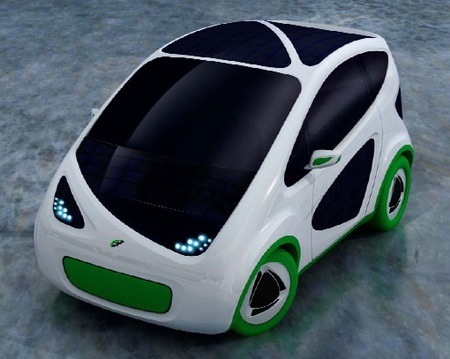
Fiat shows solar-panel wrapped 'Panda of the future'


'Leccy Tech Fiat's latest take on the electric car, the Phylla, has been revealed at the Turin Environment Park.

Weighing just 750kg – of which 150kg is the battery pack – the 2+2 Phylla has a quoted range of 145km from a lithium-ion battery pack, or 220km from a lithium polymer unit. Performance? 0-30mph takes six seconds and the top speed is just over 80mph.

Recharge time from a domestic wall socket is said to take between three and four hours, while nearly every available inch of body work is covered in solar panels which are said to generate up to 340W. The electric motor provides drive to all four wheels and has an average power output of 27kW and a peak output of 54kW.

No announcements were made regarding the potential manufacture of the Phylla, so its real importance is an indicator of what Fiat think a 'leccy Panda may look like a few years down the road.


More about the Panda from regharware (pics)

Wednesday, October 29, 2008

UPS to Test Hydraulic Hybrid Vehicles


In partnership with the US Environmental Protection Agency, UPS will begin testing a small fleet of hydraulic hybrid delivery trucks in the United States. The new vehicles can achieve 50-70% better fuel economy, a 40% reduction in greenhouse gas emissions, and pay for their extra expense in less than 3 years.

In a series hydraulic hybrid, the conventional drivetrain is replaced with a hydraulic system that stores energy by compressing gas in a chamber using hydraulic fluid. It works in much the same way that a hybrid electric car does — a small, efficient motor generates power which gets stored for later use — only, the way energy is stored in a hydraulic hybrid is in a pressurized chamber rather than in a battery.

More about UPS's Hydraulic Hybrid Vehicles

Wednesday, September 17, 2008

10 Electric Cars You Can Buy Today


Ecomodder has an article about 10 cars, from the $6,795 Gem to the $435,000 Venturi that are available to buy today. Read from Ecomodder.

Thursday, August 28, 2008

Ford Tests Improve Gas Mileage 24% with EcoDriving


Recently, Ford and a group called Pro Formance decided to take on ecodriving in the form of a 4-day long seminar with 48 different drivers taking part. Using the ecodriving tips taught by Pro Formance, the participants increased their fuel economy between 6-50%, with and average increase of 24%.

Ford Tips are:
1. Slow down and watch speed – Drive 55 miles per hour instead of 65 to save fuel.

2. Accelerate and brake smoothly

3. No idling

4. Check your tires

5. Be kind to your vehicle

6. Travel light

7. Minimize use of heater and air conditioning

8. Close windows at high speeds

9. Choose the right oil

10. Consolidate trips


Via ecomodder.

Wednesday, August 6, 2008

Tesla Founder Martin Eberhard's first impressions in the Roadster


There has been a lot of speculation about how ousted former Tesla Motors CEO Martin Eberhard would feel about the car that became the Roadster in his absence. Well, the speculation is over - his beautiful, custom-painted Roadster saw over 1000 miles of driving in the past few weeks and he wrote a very long blog post about his adventures. The highs (and lows) are as follows:


PROS:


1. The Roadster can take trips "that would have been completely out of the question for any prior production EV." He means in both distance and terrain - the Roadster handles hills and turns as well as any traditional fuel car on the road as well.
2. He comfortably took the car 125 miles on one charge and would feel comfortable going another 30 - this is with no pampering at all.
3. We need "a new list of expressions" to describe what "full throttle" feels like in the Roadster. He was extremely complimentary of the performance, " I have never driven anything like the Roadster that makes such awesome power so accessible."
4. Once the soft top is in place (he thinks it will take only 1 minute once he's used to it), it feels snug and tight.
5. The Roadster qualifies for "Clean Air Stickers" to enable free bridge crossings (at least in the Bay Area.) Not exactly the biggest concern for someone in a $100k car, but still...


CONS (he didn't pull any punches):


1. "The potholes in SF demonstrated a bit of harshness in the rear suspension – the right sort of pothole causes a very loud clunk that shakes the frame of the car." That said, he also commented that he would definitely not want to make the ride any softer.
2. Visibility is a bit of a challenge - the rear view mirror takes up so much of the windshield that it creates a legitimate blind spot.
3. It's lacking minor ammenities...for example, there is no place to stash change for parking. Small example, but he meant it as representative of minor design failures.
4. Apparently, the "JVC radio-CD player-nav system-vegematic thingy" SUCKS, "The thing runs some Microsoft operating system (really!), and it behaves just like you might expect. Or more like a Mac-righteous Apple fan might expect it to behave." Changing stations is hard, the driving directions are bad, etc.

Read more via greenhome.

Tuesday, July 15, 2008

200mph electric car able to zip along a monorail


This working prototype was built for a mere $2500, and spends most of its life as an ultralight 3-wheeled electric runabout. But if its inventors Jay Andress and Andy Webster can raise $10 million, they’re going to create a one-mile test monorail that hooks up to those wheels on the car’s roof.

While riding the electric rails, the car can accelerate to 200mph, and charge its batteries as it goes. All the while, the driver can relax and leave the driving to the computers and rails. Then, once the monorail section of the trip gets the car close to its destination, it can drive the rest of the way under its own freshly charged electric power.

The biggest catch is building the $500 billion worth of rails to accommodate a country full of such vehicles riding along the corridors of Interstate highways. But its developers say the system could pay for itself in energy savings in a year.
MonoMobile, via Autobloggreen

Via Audos.

Monday, July 7, 2008

National speed limit pushed as gas saver

An influential Republican senator suggested Thursday that Congress might want to consider reimposing a national speed limit to save gasoline and possibly ease fuel prices.

Sen. John Warner, R-Virginia, asked Energy Secretary Samuel Bodman to look into what speed limit would provide optimum gasoline efficiency given current technology. He said he wants to know if the administration might support efforts in Congress to require a lower speed limit.

Congress in 1974 set a national 55 mph speed limit because of energy shortages caused by the Arab oil embargo. The speed limit was repealed in 1995 when crude oil dipped to $17 a barrel and gasoline cost $1.10 a gallon.

As motorists headed on trips for this Fourth of July weekend, gasoline averaged $4.10 a gallon nationwide, with oil hovering around $145 a barrel.

Warner cited studies that showed the 55 mph speed limit saved 167,000 barrels of oil a day, or 2 percent of the country's highway fuel consumption, while avoiding up to 4,000 traffic deaths a year.

"Given the significant increase in the number of vehicles on America's highway system from 1974 to 2008, one could assume that the amount of fuel that could be conserved today is far greater," Warner wrote Bodman.

Warner asked the department to determine at what speeds vehicles would be most fuel efficient, how much fuel savings would be achieved, and whether it would be reasonable to assume there would be a reduction in prices at the pump if the speed limit were lowered.

From CNN.

Toyota to add solar panels to Prius hybrid

Toyota Motor Corp plans to install solar panels on its next-generation Prius hybrid cars, becoming the first major automaker to use solar power for a vehicle, the Nikkei business daily reported on Monday.

The paper said Toyota would equip solar panels on the roof of the high-end version of the Prius when it redesigns the gasoline-electric hybrid car early next year, and the power generated by the system would be used for the air conditioning.

Toyota plans to use solar panels made by Kyocera Corp (6971.T: Quote, Profile, Research, Stock Buzz), the Nikkei said.

Via Reuters

Thursday, June 19, 2008

How To Run Your Car on Free Vegetable Oil in 8 Easy Steps

Wouldn’t it be great to pack-up the car or the SUV for a weekend excursion without fretting over the cost of fuel? Or take that road trip you and your friends keep talking about? All with no concern about pumping all of your hard-earned cash into the gas tank. Heck, it would be great just to drive around town without that concern. Here’s how you can do it.

If you spend $50/week on fuel, it will take one year and two months for your program to pay for itself.

Read from The Traveler's Notebook.

Tuesday, June 10, 2008

ZENN Motors Claims Ultracapacitors Is Holy Grail for Electric Cars


Ultracapacitors: the future of electric cars or the ‘cold fusion’ of autovation?

ZENN Motors says its electric car will cruise for 250 miles on a single five-minute charge. Skeptics cry shenanigans.

Ian Clifford wants to start a global revolution by building a practical, everyday car with no gasoline engine, no batteries, and no emissions.

While big Detroit automakers ponder a future plug-in car that goes 40 miles on a battery charge before its gas engine kicks in, Mr. Clifford’s tiny ZENN Motor, a Toronto maker of low-speed electric cars, announced in March that it will build a new highway-speed (80 m.p.h.) model that goes 250 miles on a charge – and can recharge in just five minutes.

Having no batteries, the new “cityZENN” model will use a breakthrough version of a common electrical storage device called an ultracapacitor to store power from a wall socket, the company says. Fuel costs to operate it would be about one-tenth of today’s gas-powered vehicle.

If that astounding claim is real (and there are many skeptics), it could revolutionize automotive travel by making all-electric cars competitive with gas-powered vehicles and easing the world’s dependence on oil.

The reported breakthrough was made by ZENN’s business partner EEStor, a Cedar Park, Texas, firm headed by respected computer industry veteran Richard Weir, who’s named on the company’s patent. The company is now nearing commercial production of its new “electrical energy storage unit” or EESU, Clifford says.

But privately held EEStor has had little to say publicly or to the press – and that secretiveness has inspired incredulity among many debating the topic on Internet forums.

But in a break with that tradition, Tom Weir, the company’s vice president and general manager, responded to e-mailed questions.

“EEStor’s technology has the opportunity to touch every aspect of daily life from very big to very small devices,” Mr. Weir writes. “We also see a whole new generation of products … based around our technology.”

Added credibility arrived with the January announcement by Lockheed Martin, the big defense company, of an agreement to use EEStor technology for military and homeland security applications. It refers to the EEStor “ceramic battery” providing “10 times the energy density of lead-acid batteries at 1/10th the weight and volume.”

In 2005, Kleiner Perkins Caufield & Byers sunk $3 million into EEStor. ZENN also invested $3 million and will get exclusive rights to retrofit vehicles with the system – and produce new mid-size cars using EESUs.


Read from the Christian Science Monitor

Thursday, May 29, 2008

The $20K TRIAC EV


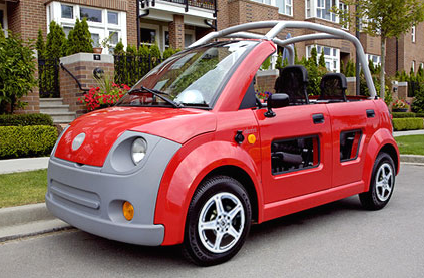
TRIAC Electric Car. Range: 60-100 Miles. Cost: 2 cents per mile

This little number has been getting some good press lately (see EcoGeek and Inhabit), and for good reason: it’s the first commercially available electric vehicle with a price tag and functionality that could meet the needs of the average city driver (assuming you can afford it).

OK, you aren’t going to fit a family of 5 in there, but that’s not what it’s made for. Green Vehicles, manufacturer of the 3-wheeled TRIAC EV, calls it a “modern freeway commuter,” because the zero-emissions vehicle can reach 80 mph and will get you into the carpool lane with a single driver. Safety-wise, it has a structural steel cage the company says is the “same metal skeleton used in race cars” and a low center of gravity to maintain balance (but surprisingly has no airbags).

Back at home, it takes about 6 hours to charge the car’s lithium-ion batteries at an estimated cost of about 2 cents per mile. Not a bad deal if you can afford the $20,000 price tag. The company website says the TRIAC EV is currently available at dealerships in San Jose and Mill Valley, California, and should be more widely available in the future.

Link via Gas 2.0, for the manufacturer click here.

Eight reasons higher prices will do us a world of good


Americans should be celebrating rather than shuddering over the arrival of $4-a-gallon gasoline. We lived on cheap gas too long, failed to innovate and now face the consequences of competing for a finite resource amid fast-expanding global demand.
A further price rise as in Europe to $8 a gallon -- or $200 and more to fill a large SUV's tank -- would be a catalyst for economic, political and social change of profound national and global impact. We could face an economic squeeze, but it would be the pain before the gain.
The U.S. economy absorbed a tripling in gas prices in the last six years without falling into recession, at least through March. Ravenous demand from China and India could see prices further double in the next few years -- and jumpstart the overdue process of weaning ourselves off fossil fuels.
Consider the world of good that would come of pricing crude oil and gasoline at levels that would strain our finances as much as they're straining international relations and the planet's long-term health:
1. RIP for the internal-combustion engine
2. Economic stimulus
3. Wither the Middle East's clout
4. Deflating oil potentates
5. Mass-transit development

From MarketWatch.

Natural Gas Powered Vehicles

I did some research, and found that compressed-natural-gas vehicles are fetching big premiums online in places like Utah and Oklahoma where natural-gas prices are ridiculously low—as low as 60-cents per gallon. When I listed the car on eBay, it sold three days later to someone in Oklahoma for $18,600, about $4,000 more than what I paid for the car when I purchased it from Honda less than a year before, and $2,000 above its Kelley Blue Book value. (The sale price to me reflected various state and federal tax incentives that Honda took when they owned it.)

Who’d have thought that the highest-performing investment of my entire year would be a used Honda Civic? We loved owning the car, and will miss its greenest-car-on-earth cache. But we realized that living five miles from work is probably better for the environment than living 65 miles from work, no matter what you drive.

Via RideLust. Note that this is a common trend in countries like Brazil.

Wednesday, May 28, 2008

Truth or Consequences: $4+ for a Gallon of Gas Should be Mandatory?

Imagine for a minute, just a minute, that someone running for president was able to actually tell the truth, the real truth, to the American people about what would be the best — I mean really the best — energy policy for the long-term economic health and security of our country. I realize this is a fantasy, but play along with me for a minute. What would this mythical, totally imaginary, truth-telling candidate say?

For starters, he or she would explain that there is no short-term fix for gasoline prices. Prices are what they are as a result of rising global oil demand from India, China and a rapidly growing Middle East on top of our own increasing consumption, a shortage of “sweet” crude that is used for the diesel fuel that Europe is highly dependent upon and our own neglect of effective energy policy for 30 years.

No, our mythical candidate would say the long-term answer is to go exactly the other way: guarantee people a high price of gasoline — forever.

This candidate would note that $4-a-gallon gasoline is really starting to impact driving behavior and buying behavior in way that $3-a-gallon gas did not. The first time we got such a strong price signal, after the 1973 oil shock, we responded as a country by demanding and producing more fuel-efficient cars. But as soon as oil prices started falling in the late 1980s and early 1990s, we let Detroit get us readdicted to gas guzzlers, and the price steadily crept back up to where it is today.

We must not make that mistake again. Therefore, what our mythical candidate would be proposing, argues the energy economist Philip Verleger Jr., is a “price floor” for gasoline: $4 a gallon for regular unleaded, which is still half the going rate in Europe today. Washington would declare that it would never let the price fall below that level. If it does, it would increase the federal gasoline tax on a monthly basis to make up the difference between the pump price and the market price.


More on the NY Times.

Sweden turning sewage into a gasoline substitute


Chemically, biogas is the same as natural gas from fossil fuels, but its manufacture relies on a process where bacteria feed on fecal waste for about three weeks in an oxygen-free chamber. The result is two-thirds methane and one-third carbon dioxide, as well as a nutrient-rich residue that can be used as soil or construction material.

Once the methane is purified, it is pumped through Goteborg's network of gas pipelines to specialized filling stations, where it is pressurized for delivery. Any car with an engine and tank configured for compressed natural gas can use biogas.

After each fill-up, the corresponding amount of biogas is injected into the natural gas grid as an offset, said Bo Ramberg, chief executive of FordonsGas, which is based in Goteborg and operates the largest chain of biogas filling stations in Scandinavia.

Ola Fredriksson, an engineer at Gryaab, the sewage facility in Goteborg, said that what an average person flushed down the toilet each year created enough biogas to drive 120 kilometers, or 75 miles.

"If the oil price keeps on going up, and people are prepared to pay more for renewable energy, then it will make our company interested in producing more biogas," he said. "We have the capacity.'

More on the Herald Tribune.