Showing posts with label electric. Show all posts

Monday, January 12, 2009

New Honda Insight: 63.4mpg!


Honda may not have been first to market with a modern hybrid electric vehicle, but the original Insight did beat the Toyota Prius to the US by a few months. As so many other companies have discovered over the years, being first doesn't necessarily guarantee success. You also need the right product for the market at the time. The original Insight had a lot of interesting technology, but it also suffered from some of the same limitations that doomed the EV1.

Still, the original Insight soldiered on from 1999 to 2006 with the Civic hybrid, using the same technology, joining it in 2002. As 2009 kicks off, Honda is launching a new hybrid-only model that revives the Insight name on an altogether more practical machine. This time Honda is aiming for real mass market appeal with a price the company hopes will make the new Insight "The Hybrid for Everyone." Honda invited us out to Arizona before Christmas to sample the new Insight and we can now tell you all about it. Read on to find out if Honda's Insight is on target.


Read and see more photos at autoblog.

Thursday, January 8, 2009

Garage Invention Turns Restaurants Into Power Plants


A new garage-engineered generator burns the waste oil from restaurants' deep fryers to generate electricity and hot water. Put 80 gallons of grease into the Vegawatt each week, and its creators promise it will generate about 5 kilowatts of power.
That's about 10 percent of the total energy needs of Finz, a seafood restaurant in Dedham, Massachusetts, where the first Vegawatt is being tested. At New England electricity rates, the system offsets about $2.50 worth of electricity with each gallon of waste oil poured into it.
Vegawatt's founder and inventor, James Peret, estimates that restaurants purchasing the $22,000 machine will save about $1,000 per month in electricity costs, for a payback time of two years.


From Wired. Would you like power with those fries?

Tuesday, December 16, 2008

Tesla Electric Car Smokes Lotus Elise (Top Gear)


"Not bad for a motor that is the size of a watermelon and only has one moving part!"

Tuesday, December 9, 2008

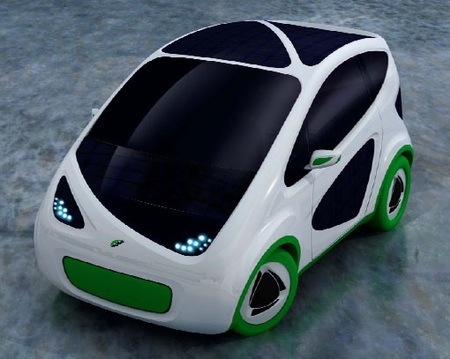
Fiat shows solar-panel wrapped 'Panda of the future'


'Leccy Tech Fiat's latest take on the electric car, the Phylla, has been revealed at the Turin Environment Park.

Weighing just 750kg – of which 150kg is the battery pack – the 2+2 Phylla has a quoted range of 145km from a lithium-ion battery pack, or 220km from a lithium polymer unit. Performance? 0-30mph takes six seconds and the top speed is just over 80mph.

Recharge time from a domestic wall socket is said to take between three and four hours, while nearly every available inch of body work is covered in solar panels which are said to generate up to 340W. The electric motor provides drive to all four wheels and has an average power output of 27kW and a peak output of 54kW.

No announcements were made regarding the potential manufacture of the Phylla, so its real importance is an indicator of what Fiat think a 'leccy Panda may look like a few years down the road.


More about the Panda from regharware (pics)

Wednesday, September 17, 2008

10 Electric Cars You Can Buy Today


Ecomodder has an article about 10 cars, from the $6,795 Gem to the $435,000 Venturi that are available to buy today. Read from Ecomodder.

Wednesday, August 6, 2008

Tesla Founder Martin Eberhard's first impressions in the Roadster


There has been a lot of speculation about how ousted former Tesla Motors CEO Martin Eberhard would feel about the car that became the Roadster in his absence. Well, the speculation is over - his beautiful, custom-painted Roadster saw over 1000 miles of driving in the past few weeks and he wrote a very long blog post about his adventures. The highs (and lows) are as follows:


PROS:


1. The Roadster can take trips "that would have been completely out of the question for any prior production EV." He means in both distance and terrain - the Roadster handles hills and turns as well as any traditional fuel car on the road as well.
2. He comfortably took the car 125 miles on one charge and would feel comfortable going another 30 - this is with no pampering at all.
3. We need "a new list of expressions" to describe what "full throttle" feels like in the Roadster. He was extremely complimentary of the performance, " I have never driven anything like the Roadster that makes such awesome power so accessible."
4. Once the soft top is in place (he thinks it will take only 1 minute once he's used to it), it feels snug and tight.
5. The Roadster qualifies for "Clean Air Stickers" to enable free bridge crossings (at least in the Bay Area.) Not exactly the biggest concern for someone in a $100k car, but still...


CONS (he didn't pull any punches):


1. "The potholes in SF demonstrated a bit of harshness in the rear suspension – the right sort of pothole causes a very loud clunk that shakes the frame of the car." That said, he also commented that he would definitely not want to make the ride any softer.
2. Visibility is a bit of a challenge - the rear view mirror takes up so much of the windshield that it creates a legitimate blind spot.
3. It's lacking minor ammenities...for example, there is no place to stash change for parking. Small example, but he meant it as representative of minor design failures.
4. Apparently, the "JVC radio-CD player-nav system-vegematic thingy" SUCKS, "The thing runs some Microsoft operating system (really!), and it behaves just like you might expect. Or more like a Mac-righteous Apple fan might expect it to behave." Changing stations is hard, the driving directions are bad, etc.

Read more via greenhome.

Tuesday, July 15, 2008

200mph electric car able to zip along a monorail


This working prototype was built for a mere $2500, and spends most of its life as an ultralight 3-wheeled electric runabout. But if its inventors Jay Andress and Andy Webster can raise $10 million, they’re going to create a one-mile test monorail that hooks up to those wheels on the car’s roof.

While riding the electric rails, the car can accelerate to 200mph, and charge its batteries as it goes. All the while, the driver can relax and leave the driving to the computers and rails. Then, once the monorail section of the trip gets the car close to its destination, it can drive the rest of the way under its own freshly charged electric power.

The biggest catch is building the $500 billion worth of rails to accommodate a country full of such vehicles riding along the corridors of Interstate highways. But its developers say the system could pay for itself in energy savings in a year.
MonoMobile, via Autobloggreen

Via Audos.

Tuesday, June 10, 2008

ZENN Motors Claims Ultracapacitors Is Holy Grail for Electric Cars


Ultracapacitors: the future of electric cars or the ‘cold fusion’ of autovation?

ZENN Motors says its electric car will cruise for 250 miles on a single five-minute charge. Skeptics cry shenanigans.

Ian Clifford wants to start a global revolution by building a practical, everyday car with no gasoline engine, no batteries, and no emissions.

While big Detroit automakers ponder a future plug-in car that goes 40 miles on a battery charge before its gas engine kicks in, Mr. Clifford’s tiny ZENN Motor, a Toronto maker of low-speed electric cars, announced in March that it will build a new highway-speed (80 m.p.h.) model that goes 250 miles on a charge – and can recharge in just five minutes.

Having no batteries, the new “cityZENN” model will use a breakthrough version of a common electrical storage device called an ultracapacitor to store power from a wall socket, the company says. Fuel costs to operate it would be about one-tenth of today’s gas-powered vehicle.

If that astounding claim is real (and there are many skeptics), it could revolutionize automotive travel by making all-electric cars competitive with gas-powered vehicles and easing the world’s dependence on oil.

The reported breakthrough was made by ZENN’s business partner EEStor, a Cedar Park, Texas, firm headed by respected computer industry veteran Richard Weir, who’s named on the company’s patent. The company is now nearing commercial production of its new “electrical energy storage unit” or EESU, Clifford says.

But privately held EEStor has had little to say publicly or to the press – and that secretiveness has inspired incredulity among many debating the topic on Internet forums.

But in a break with that tradition, Tom Weir, the company’s vice president and general manager, responded to e-mailed questions.

“EEStor’s technology has the opportunity to touch every aspect of daily life from very big to very small devices,” Mr. Weir writes. “We also see a whole new generation of products … based around our technology.”

Added credibility arrived with the January announcement by Lockheed Martin, the big defense company, of an agreement to use EEStor technology for military and homeland security applications. It refers to the EEStor “ceramic battery” providing “10 times the energy density of lead-acid batteries at 1/10th the weight and volume.”

In 2005, Kleiner Perkins Caufield & Byers sunk $3 million into EEStor. ZENN also invested $3 million and will get exclusive rights to retrofit vehicles with the system – and produce new mid-size cars using EESUs.


Read from the Christian Science Monitor

Thursday, May 29, 2008

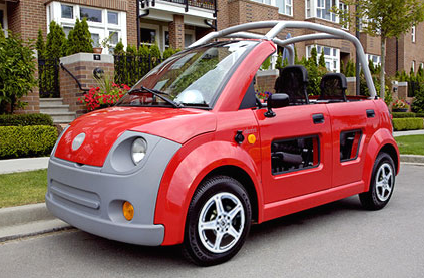
The $20K TRIAC EV


TRIAC Electric Car. Range: 60-100 Miles. Cost: 2 cents per mile

This little number has been getting some good press lately (see EcoGeek and Inhabit), and for good reason: it’s the first commercially available electric vehicle with a price tag and functionality that could meet the needs of the average city driver (assuming you can afford it).

OK, you aren’t going to fit a family of 5 in there, but that’s not what it’s made for. Green Vehicles, manufacturer of the 3-wheeled TRIAC EV, calls it a “modern freeway commuter,” because the zero-emissions vehicle can reach 80 mph and will get you into the carpool lane with a single driver. Safety-wise, it has a structural steel cage the company says is the “same metal skeleton used in race cars” and a low center of gravity to maintain balance (but surprisingly has no airbags).

Back at home, it takes about 6 hours to charge the car’s lithium-ion batteries at an estimated cost of about 2 cents per mile. Not a bad deal if you can afford the $20,000 price tag. The company website says the TRIAC EV is currently available at dealerships in San Jose and Mill Valley, California, and should be more widely available in the future.

Link via Gas 2.0, for the manufacturer click here.

Tuesday, May 27, 2008

Cost of converting entire U.S. to electric cars? Zero.


How much would it cost to convert the entire U.S. fleet of passenger cars, which collectively burn 40 percent of the oil that we use, to electric cars? Let’s look at some numbers:

* total oil consumption in the U.S.: 21 million barrels every day (CIA Factbook)
* cost per barrel: $130
* days in year: 365
* total spent per year: $1 trillion
* percentage of oil consumed by passenger cars: 40
* total spent per year on oil for passenger cars: $400 billion [refining into gasoline, distributing, and retailing add even more to this]
* at 5 interest, how much we could we borrow and pay $400 billion every year in interest: $8 trillion
* number of registered cars in the U.S.: 250 million (Wikipedia)
* cost of a new electric car, if mass-produced: $20,000
* value of a used car, if exported to Latin America or China: $5,000
* cost to upgrade average existing American car to a brand-new electric car: $15,000
* number that could be converted for $8 trillion: more than 500 million cars (i.e., twice as many as we have now)

Instead of sending $400 billion each year to countries such as Saudi Arabia and Venezuela, we could spend it on electric car production in the U.S., Mexico, and China. At current oil prices, it wouldn’t cost us a dime extra to stop importing and burning oil for passenger cars. In fact, if the goal were to end up with the same number of cars on the road, we would have a few trillion dollars left over. One or two trillion dollars would be sufficient to build nuclear, solar, or wind electric power plants to replace all of our plants that currently burn coal and oil (note that less than 1 percent of current electricity generation in the U.S. is from oil (source); most electricity that we use today is from coal, natural gas, or nuclear).

So… simply by stopping our purchases of oil we could finance the construction of power plants that emit no CO2 and electric cars that emit no CO2.

From Philip Greenspun at Harvard.

Thursday, May 22, 2008

Jay Leno Reviews the Tesla Roadster

Avoiding Power Vampires


we're talking about vampire power, phantom loads, idling standby current, and wall warts. They all basically refer to the same thing: electronic devices with two sharp, pointy teeth that latch into your wall sockets and suck blood...err...electricity all day, all night, whether on or "off," whether charging batteries or not. These devices include TV's, VCR's, DVD players, answering machines, iPods, cell phones, stereos, laptops, desktops, anything with a remote, anything with a charger, anything with a clock display. They are everywhere. Lurking.

Top 10 ways for you to fight the vampires

1. Unplug your devices
2. Reduce your demand
3. Use the other off switch
4. Plug your devices and chargers into a power strip
5. Remove chargers from the wall when you're not charging
6. If you're in the market for new electronics, buy Energy Star qualified.
7. Get a phone that tells you to unplug it.
8. For your various computer accessories, try a smart strip.
10. If you're up for a whole house project, check out GreenSwitch

Basics of vampire power

Most people think that when you turn something off, it actually turns off. Most people assume that it stops drawing power. Unfortunately, that's not true in the case of most electric devices. Most of them just hover in standby mode, waiting for you to 'turn on' the power again.

A 1999 study in New Zealand conducted by the Energy Efficiency and Conservation Authority indicated that 40% of microwave ovens used more electricity to power the clock and the keypad over the course of the year than actually heating food. Big screen TV's (and their respective cable boxes and satellites) up to 30 watts when off. A computer left turned on can potentially draw as much current as a refrigerator. And what about those chargers? Even when your cell phone (or other battery operated device) isn't charging, even if it's not even plugged in, it's still drawing power. It may even add as much as 10% to your energy bill.

This is bad news for your wallet and bad news for the environment. Studies conducted by the Lawrence Berkeley National Laboratory estimate that standby power consumption in the US accounts for 5% of all residential power consumption. That means Americans spend more than $3.5 billion annually on wasted power. It also means that our standby power is responsible for 27 tons of carbon dioxide emissions.

The International Energy Agency (IEA) estimates that globally standby power is responsible for 1% of carbon dioxide emissions (to contextualize that number, it is estimated that 2-3% of CO2 emissions are from air travel). And let's be honest. Those numbers are probably growing given the affinity many of us have for new gadgets and fancy appliances.

Read from Green Home.

Wednesday, May 21, 2008

N. Texan Builds Car That Costs $7 For Every 300 Miles


KENNEDALE, Texas --
With gas pushing $4 per gallon, many people are looking for ways to save some green at the pump. One North Texas man found a way to help the environment and commute to work for just pennies a day.

"The most common question I get is, ‘Is this an electric car?’ and then they're like, "Is it a hybrid?’ Nope, it's a real electric (car)," Murray said.

When his car is low on fuel, Murray simply plugs the power cord into the nearest outlet.

"Yeah, just plug it in here. Just a regular old extension cord," Murray said.

The self-described computer geek from Kennedale bought the 1993 Eagle Talon from a junkyard for just $750.

"First thing I did when I got the car home was pull the engine out," Murray said.

He then spent about $4,000 more to convert the gas-guzzler to run on electricity alone, doing all the work himself in his garage at home.

"I bought the electric motor and I was like well, I gotta figure out a way to couple it together with the original transmission,” he said.

The car can hit 55 mph, driving right past the high prices at gas stations.

"I hear people complain about them at work all the time. I just grin," he said.

Murray spends just $7 per month on electricity to charge the batteries -- enough to go about 300 miles.

"I don't even look at the gas prices," Murray said.

More, and video, from NBC.

Tuesday, May 20, 2008

Homemade power banishes the bills


Charmaine Watts hasn't had a power bill for eight years.

Her family of two adults and three children are one of hundreds around the country generating their own electricity.

With power prices on the rise, the $20,000 the Watts spent installing solar panels, a small wind turbine, storage batteries and wiring is starting to look like a good investment.

"I don't need to worry about power cuts," said Ms Watts. "It's just like a normal house. I flick the switch on my computer or my DVD player and away I go."

Watts is the head of the Sustainable Electricity Association of New Zealand, a group representing small-scale wind, hydro and solar power generators. Nobody knows exactly how many families generate their own power, but together it's thought they make between 5 and 6 megawatts of power a year - a drop in the bucket when measured against Meridian's planned West Wind wind farm near Wellington and its 142 megawatt production.

"Anyone with a roof has the potential to make their own electricity."

Mr Prior said solar generation would be affordable for most people only if the Government followed Germany and Australia and subsidised renewable power. "The market exploded in Germany. Manufacturers couldn't make enough panels," said Mr Prior. "The trouble here is the Government gets a return from state-owned renewable generators like Meridian Energy, so there's not much incentive to provide subsidies."

"We've saved something like 10,000 tonnes in carbon dioxide since 2000 by using natural, renewable energy."

More from the NZ Herald.

Monday, May 19, 2008

MythBuster: Why Electric Vehicles Beat Gas in 5 Extreme Tests


I'm really big on electric vehicles because the total amount of fuel consumption involved is much less than what gas vehicles consume thanks to the efficiencies involved in a power generating plant. But there's a lot of talk out there that electric vehicles just don't perform as well as their gas counterparts—and, because we want to keep the planet intact, it sounded like a good myth to bust. So we decided to put gas and electric models of compact cars, ATVs, motorcycles and go-karts head-to-head on the track and the road to figure out if electric could hold its own.
(...)
Besides almost zero emissions, electric vehicles also have some very distinct advantages: An electric ATV is quiet, healthier to have around crops, and you don’t need it to go 300 miles on a charge. Barefoot’s prototype is running 2.5 hours of average use on a charge and is back to 80 percent charge over a lunch break, which is more than adequate run time on a farm or vineyard. Our highways and neighborhoods will be quieter and cleaner with electric cars and motorcycles on them.

Building an electric go-kart or ATV is not any more difficult than making a radio-control electric car. Sure, we’re using welders instead of pre-made plastic parts, but you’ve got an electric motor, a bank of batteries and a speed controller. Look at your racing RC toys—it’s the same thing. The home-built electric car we tested had serious limitations, but I think I could build one that doesn’t have those problems. I fully intend to make a full-size electric car; I figure it’d take about $28,000 worth of components for a plus-300-mile range. It should take me about a week or two to build—tops.

Read from Popular Mechanics.