Showing posts with label oil. Show all posts

Thursday, June 11, 2009

House Passes 'Cash for Clunkers' Bill


The House passed a plan to boost auto sales by providing vouchers of up to $4,500 for consumers who turn in their gas-guzzling cars and trucks for more fuel-efficient vehicles.

Under the House bill, car owners could get a voucher worth $3,500 if they traded in a vehicle getting 18 miles per gallon or less for one getting at least 22 miles per gallon. The value of the voucher would grow to $4,500 if the mileage of the new car is 10 mpg higher than the old vehicle. The miles per gallon figures are listed on the window sticker.

Owners of sport-utility vehicles, pickup trucks or minivans that get 18 mpg or less could receive a voucher for $3,500 if their new truck or SUV is at least 2 mpg higher than their old vehicle. The voucher would increase to $4,500 if the mileage of the new truck or SUV is at least 5 mpg higher than the older vehicle. Consumers could also receive vouchers for leased vehicles.


More from the Wall Street Journal

Tuesday, September 16, 2008

Offshore Drilling is a Non-Issue


A picture is worth 1,000 words... From architecture2030

Tuesday, June 10, 2008

60% of today’s oil price may be pure speculation


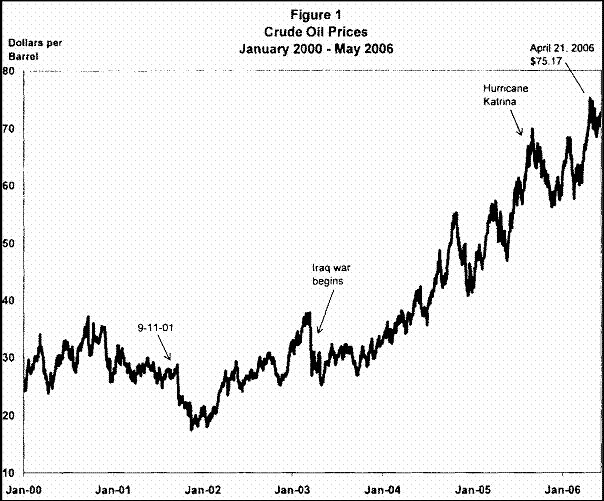
The price of crude oil today is not made according to any traditional relation of supply to demand. It’s controlled by an elaborate financial market system as well as by the four major Anglo-American oil companies. As much as 60% of today’s crude oil price is pure speculation driven by large trader banks and hedge funds. It has nothing to do with the convenient myths of Peak Oil. It has to do with control of oil and its price. How?

As a result, over the past two years crude oil inventories have been steadily growing, resulting in US crude oil inventories that are now higher than at any time in the previous eight years. The large influx of speculative investment into oil futures has led to a situation where we have both high supplies of crude oil and high crude oil prices.

Compelling evidence also suggests that the oft-cited geopolitical, economic, and natural factors do not explain the recent rise in energy prices can be seen in the actual data on crude oil supply and demand. Although demand has significantly increased over the past few years, so have supplies.

Over the past couple of years global crude oil production has increased along with the increases in demand; in fact, during this period global supplies have exceeded demand, according to the US Department of Energy. The US Department of Energy’s Energy Information Administration (EIA) recently forecast that in the next few years global surplus production capacity will continue to grow to between 3 and 5 million barrels per day by 2010, thereby “substantially thickening the surplus capacity cushion.”


Read explanation from globalresearch.ca

Wednesday, May 28, 2008

Truth or Consequences: $4+ for a Gallon of Gas Should be Mandatory?

Imagine for a minute, just a minute, that someone running for president was able to actually tell the truth, the real truth, to the American people about what would be the best — I mean really the best — energy policy for the long-term economic health and security of our country. I realize this is a fantasy, but play along with me for a minute. What would this mythical, totally imaginary, truth-telling candidate say?

For starters, he or she would explain that there is no short-term fix for gasoline prices. Prices are what they are as a result of rising global oil demand from India, China and a rapidly growing Middle East on top of our own increasing consumption, a shortage of “sweet” crude that is used for the diesel fuel that Europe is highly dependent upon and our own neglect of effective energy policy for 30 years.

No, our mythical candidate would say the long-term answer is to go exactly the other way: guarantee people a high price of gasoline — forever.

This candidate would note that $4-a-gallon gasoline is really starting to impact driving behavior and buying behavior in way that $3-a-gallon gas did not. The first time we got such a strong price signal, after the 1973 oil shock, we responded as a country by demanding and producing more fuel-efficient cars. But as soon as oil prices started falling in the late 1980s and early 1990s, we let Detroit get us readdicted to gas guzzlers, and the price steadily crept back up to where it is today.

We must not make that mistake again. Therefore, what our mythical candidate would be proposing, argues the energy economist Philip Verleger Jr., is a “price floor” for gasoline: $4 a gallon for regular unleaded, which is still half the going rate in Europe today. Washington would declare that it would never let the price fall below that level. If it does, it would increase the federal gasoline tax on a monthly basis to make up the difference between the pump price and the market price.


More on the NY Times.

Oil's perfect storm may blow over


The perfect storm that has swept oil prices to $132 a barrel may subside over the coming months as rising crude supply from unexpected corners of the world finally comes on stream, just as the global economic downturn begins to bite.

The forces behind the meteoric price rise this spring are slowly receding. Nigeria has boosted output by 200,000 barrels a day (BPD) this month, making up most of the shortfall caused by rebel attacks on pipelines in April.

The Geneva consultancy PetroLogistics says Iraq has added 300,000 bpd to a total of 2.57m as security is beefed up in the northern Kirkuk region.

"There is a strong rebound in supply," said the group's president Conrad Gerber.

Saudi Arabia is adding 300,000 bpd to the market in response to a personal plea from President George Bush, and to placate angry Democrats on Capitol Hill - even though Riyadh insists that there are abundant supplies for sale.

The signs are already surfacing in global inventories. Opec says that stocks held by the OECD club of rich countries are above their five-year average, with "comfortable" cover for 53 days' use. US stocks have edged up for the last four months, though they fell last week.

The countries that account for the most of the growth in oil demand over the last two years are almost all nearing the limits of easy economic growth.

Read on the Telegraph.

Thursday, May 22, 2008

Biofuel Thefts Rampant?


A few years ago, drums of used french fry grease were only of interest to a small network of underground biofuel brewers, who would use the slimy oil to power their souped-up antique Mercedes.

Now, restaurants from Berkeley, California, to Sedgwick, Kansas, are reporting thefts of old cooking oil worth thousands of dollars by rustlers who are refining it into barrels of biofuel in backyard stills.

"It's like a war zone going on right now over grease," said David Levenson, who owns a grease hauling business in San Francisco's Mission District. "We're seeing more and more people stealing grease because it lets them stay away from the pump, but it's hurting our bottom line."

Levenson, who converted the engine in his '83 Mercedes to run on straight canola oil, has built up contracts to collect the liquid leftovers from 400 restaurants in the last two years.

Last week when his pump truck arrived at Thee Parkside, a dive bar known for its chili-cheese fries, his driver found someone had already helped himself to their barrel of yellow oil.

But as the price of diesel shoots up, so, too, does the value of grease.

In the last three years, the price of soybean oil -- the main feedstock for biodiesel made in the United States -- has tripled. Last week, a gallon of crude soybean oil fetched 66 cents on the open market, according to the National Biodiesel Board.

Those kinds of numbers have encouraged biofuel enthusiasts to plunder restaurants' greasy waste, and have even spurred the City of San Francisco to get into the grease-trap cleaning business.

"Restaurants and staff are no longer looking at this material as trash, they're looking at is as something that's about to go into city vehicles," said Karri Ving, who runs the city's new waste cooking oil collection program. "Unless you lock down every trash can, thefts are going to happen."

The National Biodiesel Board reports that U.S. production of biodiesel reached 500 million gallons last year, up from just 75 million gallons in 2005.

Read from CNN.