
Wednesday, May 21, 2008

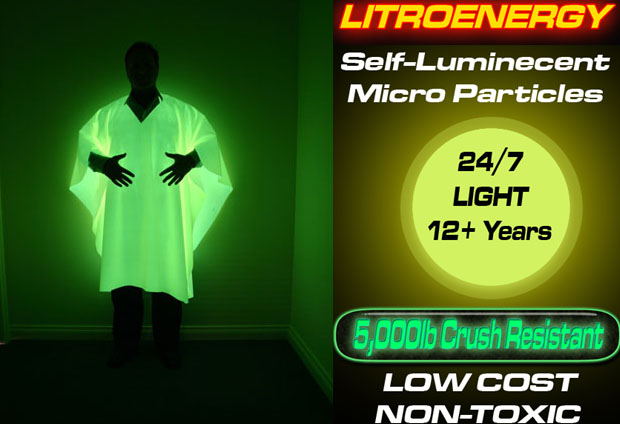
New Light Source Lasts 15 Years Without a Recharge


Disclaimer: We found this article lacking in a lot of basic information, even having typos in it. Albeit an interesting technology, it would be good to know more details like the energy cost for creating this material.

How about a glowing light source that lasts for 15 years instead of the typical 15 minutes of a glowstick? GlowPaint’s newest product does just that and is also non-toxic and inexpensive and doesn’t require a recharge via solar or electrical sources for its entire lifespan. According to the company, “This has potential to save billions in energy costs world-wide. Litroenergy™ surpasses all known available lighting options for cost/durability/reliability and safety.” Their products are expected to be used to replace other forms of safety, emergency and novelty lighting duties normally performed by glow sticks, LEDs and other light sources.

“The Litrospheres are not effected by heat or cold, and are 5,000-pound crush resistant. They can be injection molded or added to paint. The fill rate of Litroenergy micro particles in plastic injection molding material or paint is about 20%. The constant light gives off no U.V. rays, and can be designed to emit almost any color of light desired.”

From PureEnergySystems via Ecoble.

Tuesday, May 20, 2008

Homemade power banishes the bills


Charmaine Watts hasn't had a power bill for eight years.

Her family of two adults and three children are one of hundreds around the country generating their own electricity.

With power prices on the rise, the $20,000 the Watts spent installing solar panels, a small wind turbine, storage batteries and wiring is starting to look like a good investment.

"I don't need to worry about power cuts," said Ms Watts. "It's just like a normal house. I flick the switch on my computer or my DVD player and away I go."

Watts is the head of the Sustainable Electricity Association of New Zealand, a group representing small-scale wind, hydro and solar power generators. Nobody knows exactly how many families generate their own power, but together it's thought they make between 5 and 6 megawatts of power a year - a drop in the bucket when measured against Meridian's planned West Wind wind farm near Wellington and its 142 megawatt production.

"Anyone with a roof has the potential to make their own electricity."

Mr Prior said solar generation would be affordable for most people only if the Government followed Germany and Australia and subsidised renewable power. "The market exploded in Germany. Manufacturers couldn't make enough panels," said Mr Prior. "The trouble here is the Government gets a return from state-owned renewable generators like Meridian Energy, so there's not much incentive to provide subsidies."

"We've saved something like 10,000 tonnes in carbon dioxide since 2000 by using natural, renewable energy."

More from the NZ Herald.

235 MPG VW of the Future...from 2002


But Volkswagon took that extra step and made a bobsled with a diesel engine. It is, in fact, actually a car. It seats two (arguably), gets roughly 235 miles per gallon of diesel fuel and is perched at the very cutting edge aerodynamic technology. Of course, this comcept car has been around since 2002, and we're still no where near seeing it on our roads.

The car's technology comes from it's unique shape and it's ultra-light body. The frame is actually made of magnesium, an extremely light metal, and the outer skin is reinforced with carbon fiber. The one cylinder engine is made of aluminum and sits on top of the rear axle. The car is only a bit more than three feet high and weighs less than 700 lbs.

It might seem like a death trap and, if you got in a head-on with an SUV, it would be. But the car is surprisingly safe for its size, employing an excellent roll-avoidance system that makes the car virtually impossible to flip.

So...the car of the future was officially here four years ago. It could have been (and maybe still could be) a whole new class of vehicle. But nobody wants the passenger to straddle the driver in what looks to be the child of a VW Bug and a bobsled. The technology is in our hands. We choose not to use it.

From EcoGeek.

Monday, May 19, 2008

"Door to Hell" Giant Gas-Filled Hole in Uzbekistan


This place in Uzbekistan is called by locals “The Door to Hell”. It is situated near the small town of Darvaz. The story of this place lasts already for 35 years. Once the geologists were drilling for gas. Then suddenly during the drilling they have found an underground cavern, it was so big that all the drilling site with all the equipment and camps got deep deep under the ground. None dared to go down there because the cavern was filled with gas. So they ignited it so that no poisonous gas could come out of the hole, and since then, it’s burning, already for 35 years without any pause. Nobody knows how many tons of excellent gas has been burned for all those years but it just seems to be infinite there.

More photos and video at English Russia.

MythBuster: Why Electric Vehicles Beat Gas in 5 Extreme Tests


I'm really big on electric vehicles because the total amount of fuel consumption involved is much less than what gas vehicles consume thanks to the efficiencies involved in a power generating plant. But there's a lot of talk out there that electric vehicles just don't perform as well as their gas counterparts—and, because we want to keep the planet intact, it sounded like a good myth to bust. So we decided to put gas and electric models of compact cars, ATVs, motorcycles and go-karts head-to-head on the track and the road to figure out if electric could hold its own.
(...)
Besides almost zero emissions, electric vehicles also have some very distinct advantages: An electric ATV is quiet, healthier to have around crops, and you don’t need it to go 300 miles on a charge. Barefoot’s prototype is running 2.5 hours of average use on a charge and is back to 80 percent charge over a lunch break, which is more than adequate run time on a farm or vineyard. Our highways and neighborhoods will be quieter and cleaner with electric cars and motorcycles on them.

Building an electric go-kart or ATV is not any more difficult than making a radio-control electric car. Sure, we’re using welders instead of pre-made plastic parts, but you’ve got an electric motor, a bank of batteries and a speed controller. Look at your racing RC toys—it’s the same thing. The home-built electric car we tested had serious limitations, but I think I could build one that doesn’t have those problems. I fully intend to make a full-size electric car; I figure it’d take about $28,000 worth of components for a plus-300-mile range. It should take me about a week or two to build—tops.

Read from Popular Mechanics.

U.S. Can Boost Clean Wind Power for 2 Cents a Day per Household


May 17, 2008 | A stunning new report just issued by the Bush administration finds that for under 2 cents a day per household, Americans could get 300 gigawatts of wind by 2030. That would:

  • Reduce carbon dioxide emissions from electricity generation by 25 percent in 2030.
  • Reduce natural gas use by 11 percent.
  • Reduce cumulative water consumption associated with electricity generation by 4 trillion gallons by 2030.
  • Support roughly 500,000 jobs in the U.S.

The report doesn't mention that this would require adopting policies the Bush administration opposes. But that's what elections are for.

Wind power is coming of age. In 2007, some 20,000 megawatts of wind were installed globally, enough to power 6 million homes. Sadly, most wind power manufacturers are no longer American, thanks to decades of funding cuts by conservatives. Still, new wind is poised to be a bigger contributor to U.S. (and global) electricity generation than new nuclear power in the coming decades. As I have written earlier, concentrated solar power could be an even bigger power source, and it can even share power lines with wind.

That means we can realistically envision an electric grid built around renewables: electricity with no greenhouse gas emissions, no fuel cost (and no future price volatility) and no radioactive waste. But while it is poised to happen, and other governments are working hard to claim market share, America will need a bold president to ensure leadership in these major job-creating industries of the 21st century.

Read more from Salon.

$2 Billion Wind Turbine Order from Texas Oilman


Texas oilman T. Boone Pickens has placed an the largest ever order for wind turbines: he ordered 667 wind turbines from GE, each costing $3 million dollars, making the total order $2 billion. Pickens plans to develop the world’s largest wind farm in the panhandle of Texas.

The $2 billion order is just one quarter of the total amount he plans to purchase. Once built, the wind farm would have the capacity to supply power to over 1,200,000 homes in North Texas. Each turbine will produce 1.5 megawatts of electricity. The first phase of the project will produce 1,000 megawatts, enough energy to power 300,000 homes. GE will begin delivering the turbines in 2010, and current plans call for the project to start producing power in 2011.Ultimately, Picken’s company, Mesa Power, plans to have enough turbines to produce 4,000 megawatts of energy, the overall project is expected to cost $10 billion and be completed in 2014.

Via MetaEfficient.